1 August 2021 marks the 19th month anniversary of COVID-19 pandemic outbreak, and the virus continues to infect millions more every month with the highly infectious mutated Delta variant, which is now rampaging through much of Southeast Asia. When it first started in Wuhan, China it took the virus close to 4 months to reach its first million cases, but currently it takes just 2 days to record one million new cases, sadly more than 20% of the new cases are now happening in this region.
ASEAN region is now becoming the epicentre of the current Delta variant outbreak with Indonesia becoming the worst-hit country while neighbouring countries like Malaysia, Thailand, Myanmar, Philippines and Vietnam are struggling hard to contain this virus spread. Nevertheless, vaccination is going at record speed and before the end of this year, countries like Malaysia and Singapore will have more than 80% of its population vaccinated, thereby easing curbs and opening the economy, while the pandemic might soon be re-classified as endemic.
The food and beverage manufacturing industry is one industry which is resilient and still enjoying steady growth during this period. Nevertheless, the pandemic has caused tremendous strain to the industry in terms of logistics, and higher cost of plant safety and sanitation protocols. Many food factories have to close their plants temporarily whenever there are suspected or real infection cases near or within the plant. In June this year, there were already quite a handful of food manufacturers having to close their plant to prevent the spread of COVID-19. One such plant is Kawan Food facility in Klang, Malaysia. Thankfully, it can rely on its plant in Nantong, China as the latter had existing inventories to extend its production shifts upon re-commencement of manufacturing activities. Another plant affected was Charoen Pokphand Foods in May when its Saraburi factory in Thailand faced an outbreak among hundreds of its workers which resulted in the factory stopping its exports temporarily to other markets including Singapore. All these unplanned disruption to production translate to higher cost of maintaining the plant operation, and this cannot go on indefinitely.
AFBR has done a small survey covering 20 small and medium sized (SMEs) food and beverage manufacturers in Singapore, Indonesia and Thailand to get their feedback on what are their 3 important business concerns during the pandemic in 2021. The following Chart 1.0 showed the ranking based on the highest to the lowest number of concerns expressed by the respondents. It is apparent that the topmost concern, with 17 of the SMEs surveyed ranked it as one of their top 3 concerns, is the worry over disruption or closure of plant which will have a negative impact on business operations.
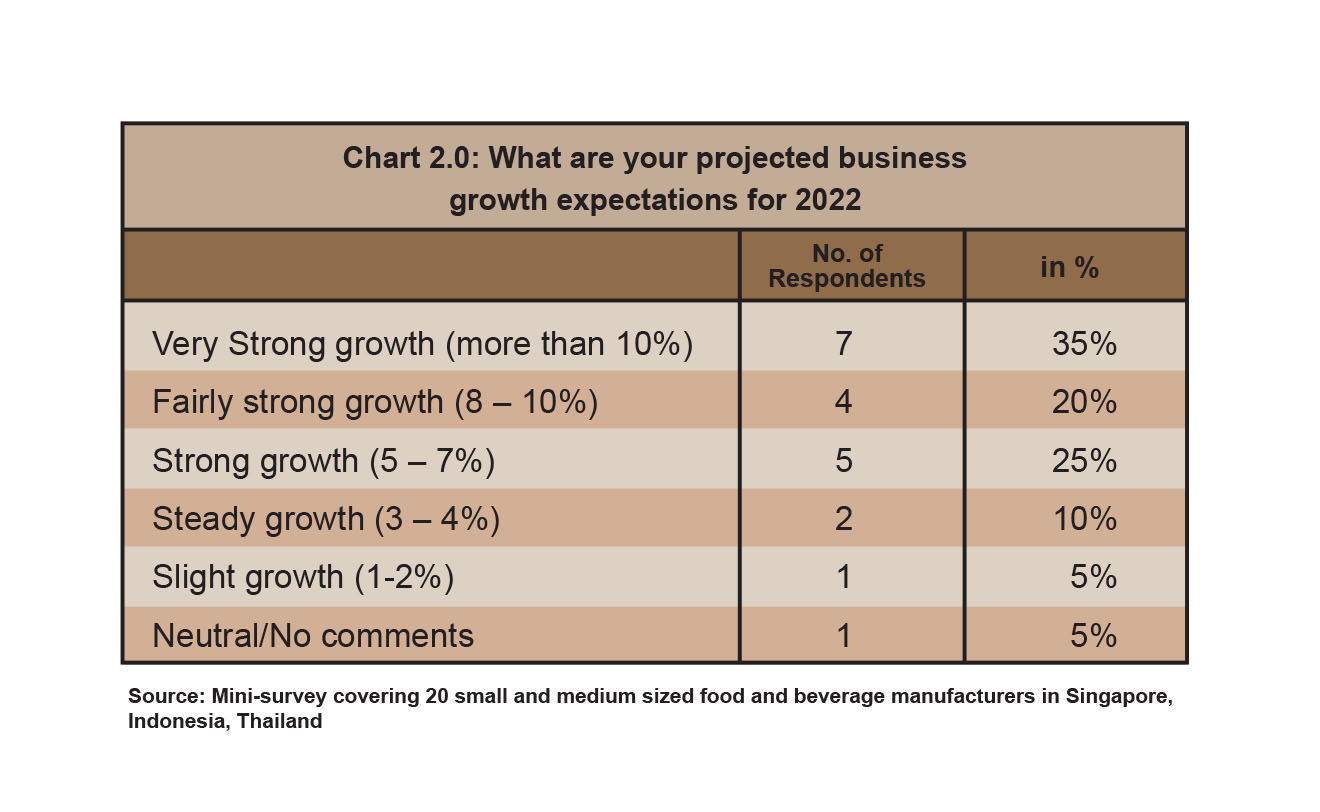
AFBR has also checked with the respondents on their business growth expectations for 2022 by asking them on their projected business growth estimate. Most are optimistic that the global economy will be in full steam and the food and beverage industry will enjoy stronger growth once majority of the population in these 3 countries get vaccinated. (see Chart 2.0)